
Wide-Temperature Reliability Testing for Industrial Displays
Part of: High-Brightness TFT LCD Engineering
·Senvita Display Engineering
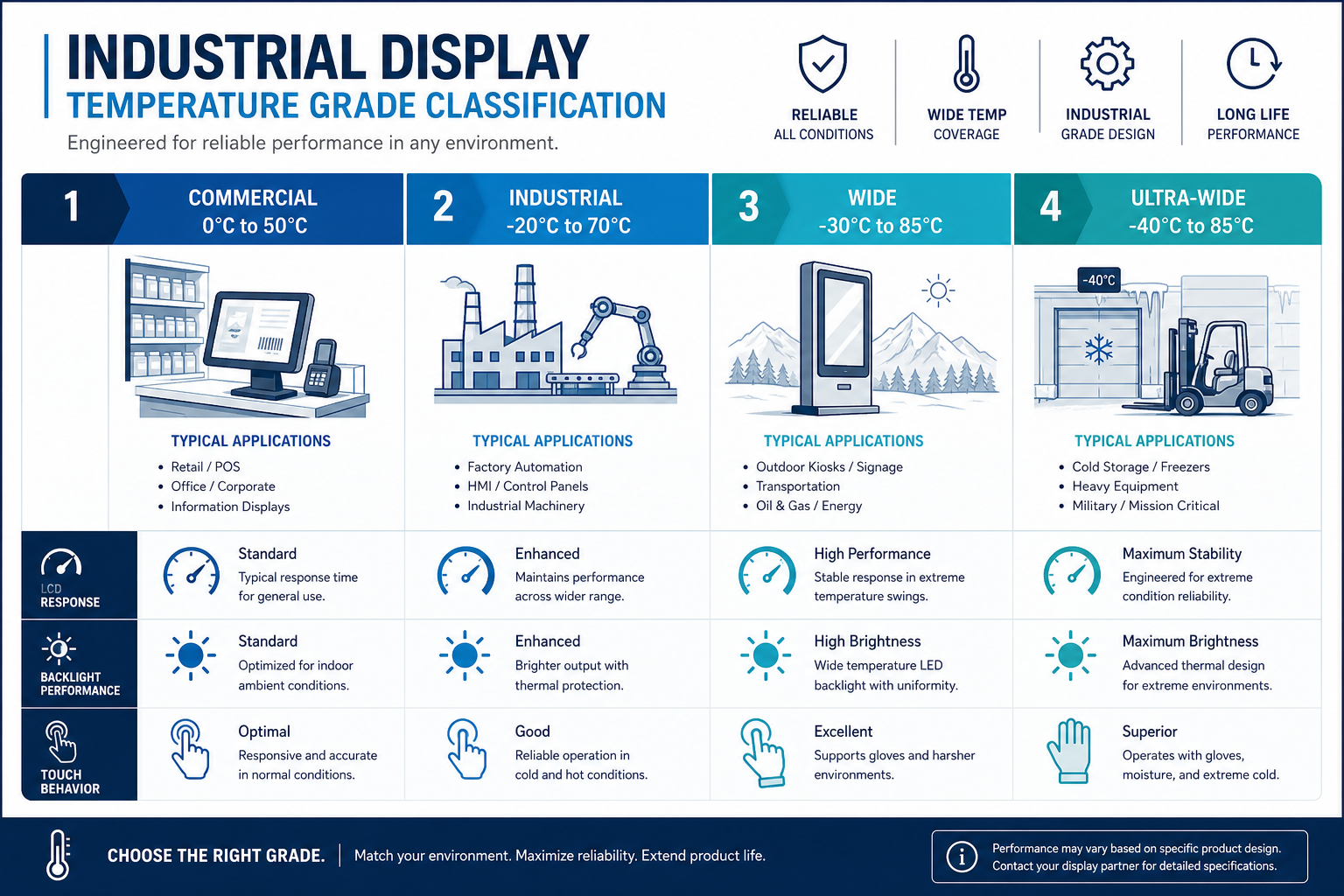
Wide-temperature reliability testing for industrial displays validates whether an LCD module, backlight, and interface chain can survive the actual temperature envelope of the product. The goal is not a pass/fail checkbox; it is to characterize where performance begins to drift and which failure modes appear first.
Definition
A useful test plan covers startup at the temperature extremes, steady-state operation under load, cycling between hot and cold, and storage exposure. The display should be tested as part of the final system whenever possible, because enclosure heat flow and cable routing can change the outcome.
- Test both cold start and hot restart behavior.
- Measure brightness, response time, and image stability at each temperature point.
- Include dwell time long enough for thermal equilibrium.
- Inspect seals, adhesive joints, connectors, and mounting features after cycling.
Problem: The display starts at room temperature but fails to initialize when cold.
Cause: Driver timing, crystal response, or power sequencing is marginal at low temperature.
Solution: Validate cold-start limits and adjust power-up timing or component selection.
Problem: The screen works across the full range but becomes slower or dimmer at hot soak.
Cause: Thermal drift affects liquid crystal response, LED output, and driver headroom.
Solution: Quantify hot-state degradation and set acceptance criteria based on actual use.
Problem: After cycling, the module develops intermittent artifacts or connector issues.
Cause: Expansion mismatch and vibration of the harness or panel stack create marginal contacts.
Solution: Add strain relief, inspect pin retention, and recheck the interface after environmental stress.
Testing should produce data that engineering can act on:
- Operating limits by temperature and duty cycle.
- Margin to failure for brightness, boot time, and display quality.
- Evidence of which parts of the stack are most temperature-sensitive.
- Clear acceptance criteria for production and field qualification.
This work connects directly to Thermal Management for LCD Modules and High-Brightness TFT LCD Engineering. If the display is expected to remain readable in sunlight after thermal stress, see Sunlight-Readable Display Engineering.
For qualification methodology beyond the display itself, use industrial component qualification testing.
Validation
- Run temperature cycling, cold soak, hot soak, and storage tests with documented dwell times.
- Record optical performance, boot behavior, and any interface retries or glitches.
- Inspect for delamination, condensation marks, warp, and connector fatigue after test completion.
- Repeat on production-intent samples, not only engineering prototypes.
Wide-temperature testing is valuable when it exposes a design limit early enough to change the design. If the test cannot change the design, it is usually just documentation.