
Viewing Angle Selection for Industrial HMI Panels
Part of: Industrial TFT LCD Selection Guide
·Senvita Display Engineering
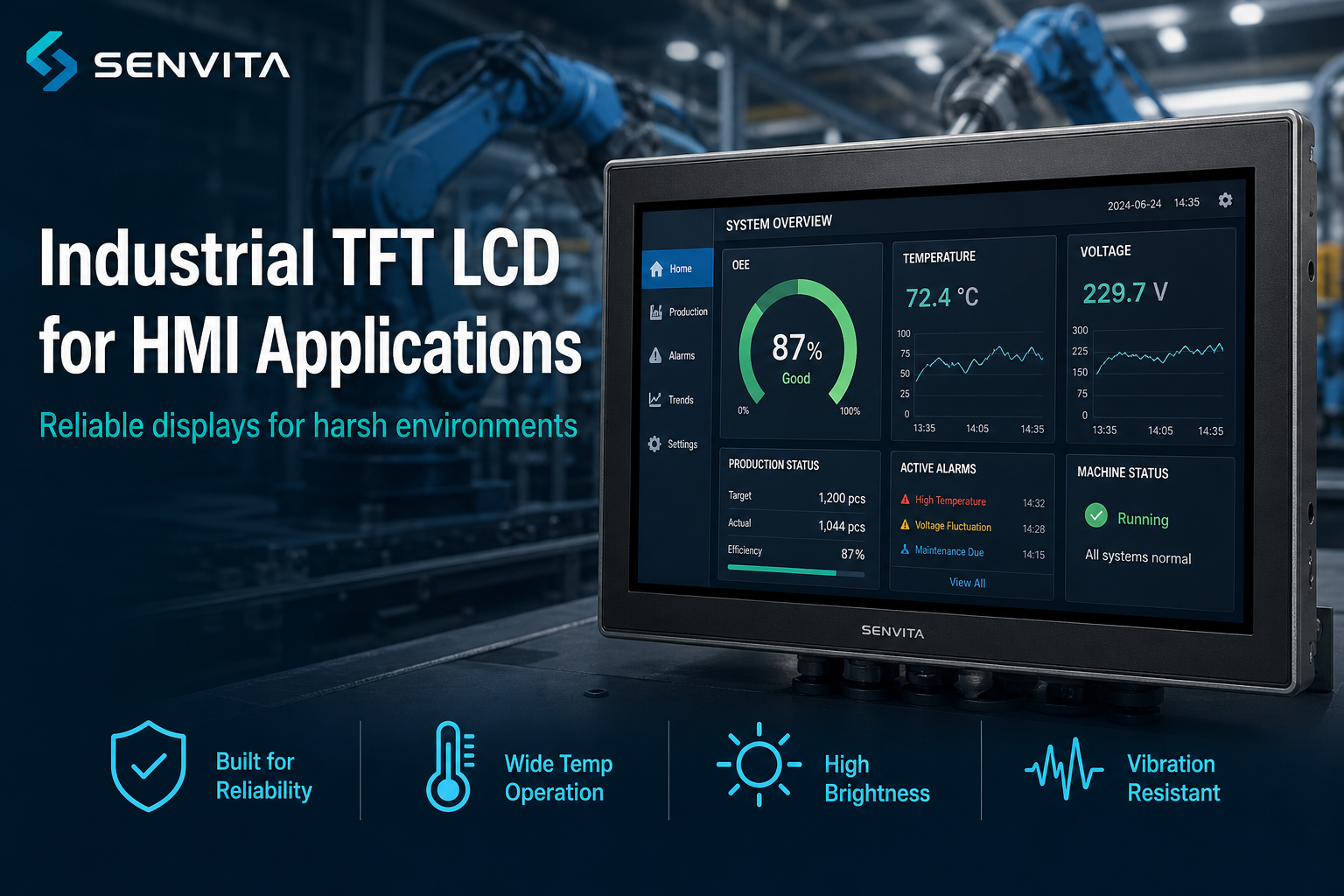
Viewing angle is a field-use requirement, not a catalog feature. For industrial HMIs, the real question is whether an operator can read the screen from the expected standing, seated, or side-access positions without color inversion, contrast collapse, or severe brightness loss.
Definition and selection boundary
Panel vendors often quote viewing angle using a symmetry criterion, but industrial use cares about usable contrast. A panel with wide nominal angles can still be poor if the bezel blocks the line of sight, the machine is mounted high, or multiple operators must read it from different positions.
- Front-facing HMI: prioritize contrast stability and low grayscale shift.
- Side-mounted cabinet panel: widen the effective angle and test off-axis readability.
- Outdoor or high-glare use: combine angle selection with brightness and anti-reflection design.
- Color-critical HMIs need tighter angle behavior than simple status screens.
Cause: The selected panel meets a data-sheet angle number but not the installed geometry and contrast requirement.
Solution: Evaluate readability at the real mount height and offset, then choose a panel family with stable off-axis contrast.
Cause: The liquid-crystal mode and polarizer stack do not preserve grayscale under the required off-axis range.
Solution: Test the panel at the expected viewing cone, not only at 0 degrees, and reject parts with excessive gamma shift.
Cause: Mechanical obstructions and reflection change the effective viewing geometry.
Solution: Include the complete front stack, and evaluate the final assembly, not the bare module.
Viewing angle must be considered together with luminance and the display stack. The related notes on High-Brightness TFT LCD Engineering, Wide-Temperature Industrial Display Design, and Display Subsystem Architecture for HMI help show how optics and mechanics interact.
Validation
Validation should use the actual enclosure, because bezel depth, glass thickness, and installation tilt change the result. Measure contrast and legibility at several angles and at the operator positions that matter most.
- Test at 0, 30, 45, and 60 degrees where applicable.
- Check both black-state contrast and grayscale legibility.
- Confirm readability under ambient light, not only in a dark room.
- Repeat after thermal soak if the liquid-crystal mode is temperature sensitive.
As with all selection work, close the loop with the Industrial TFT LCD Selection Guide before freezing the HMI mechanical design.