
How to Choose the Right TFT LCD for Industrial HMI Applications
·Senvita Display Engineering
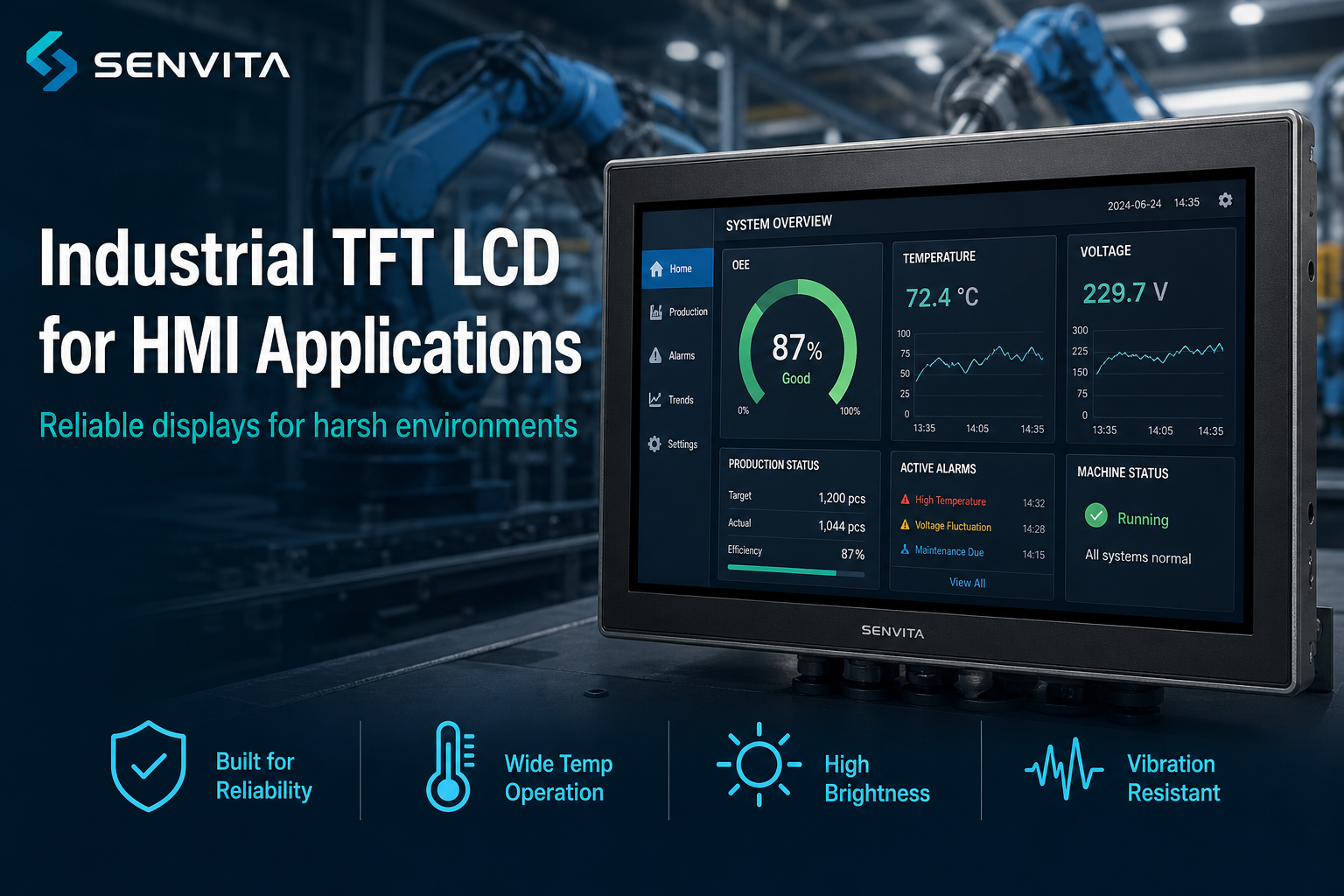
Industrial human-machine interface (HMI) systems require display solutions that go far beyond basic visual performance. Unlike consumer electronics, industrial displays must maintain stable operation under harsh environments, electrical noise, and long-term continuous operation.
Selecting the right TFT LCD is therefore not just a specification comparison—it is a system-level engineering decision that directly impacts reliability, usability, and lifecycle cost. This guide provides an engineering-oriented approach to TFT LCD selection, combined with real industrial product examples from Senvita.
1. What Makes Industrial LCD Different from Consumer Displays
1.1 Extended Temperature Operation
Industrial TFT LCD modules are typically designed for:
- -30°C to +85°C — standard industrial grade
- -40°C to +85°C — wide temperature grade
Consumer displays are usually limited to 0°C to 50°C. Temperature directly affects liquid crystal response time, gamma stability, backlight efficiency, and long-term optical degradation.
1.2 24/7 Continuous Operation
Industrial systems are often required to operate continuously without shutdown cycles. Key requirements include:
- 50,000–100,000 hours LED lifetime
- Stable backlight driver performance
- Low optical degradation over time
1.3 EMI Resistance in Industrial Environments
Industrial environments typically include motors, relays, VFD (Variable Frequency Drives), and high-power switching systems. These introduce electromagnetic interference (EMI), which can affect LVDS / MIPI signal integrity, cause display flicker, and create touch instability.
1.4 Mechanical Robustness
Industrial displays often require reinforced metal frames, vibration-resistant connectors, optical bonding (optional), and anti-glare surface treatment.
2. Key Parameters for TFT LCD Selection
2.1 Brightness (nits)
| Range | Typical Application |
|---|---|
| 300–500 nits | Indoor applications |
| 500–800 nits | Semi-industrial environments |
| 1000–1500+ nits | Outdoor / sunlight-readable |
Higher brightness increases power consumption, thermal load, and backlight aging rate—balance readability against system thermal budget.
2.2 Interface Selection
| Interface | Characteristics |
|---|---|
| LVDS | High EMI immunity, stable signal transmission, industrial standard |
| MIPI DSI | High bandwidth, modern SoC platforms, sensitive to layout quality |
| RGB | Simple architecture, lower cost, legacy systems |
Engineering note: LVDS remains the most widely used interface in industrial HMI systems due to its robustness in electrically noisy environments.
2.3 Optical Performance
Industrial HMI typically requires IPS panels for wide viewing angles, stable color performance, and reduced color shift under off-axis viewing.
2.4 Wide Temperature Performance
Required for outdoor equipment, automotive systems, and factory automation where ambient temperature swings are significant.
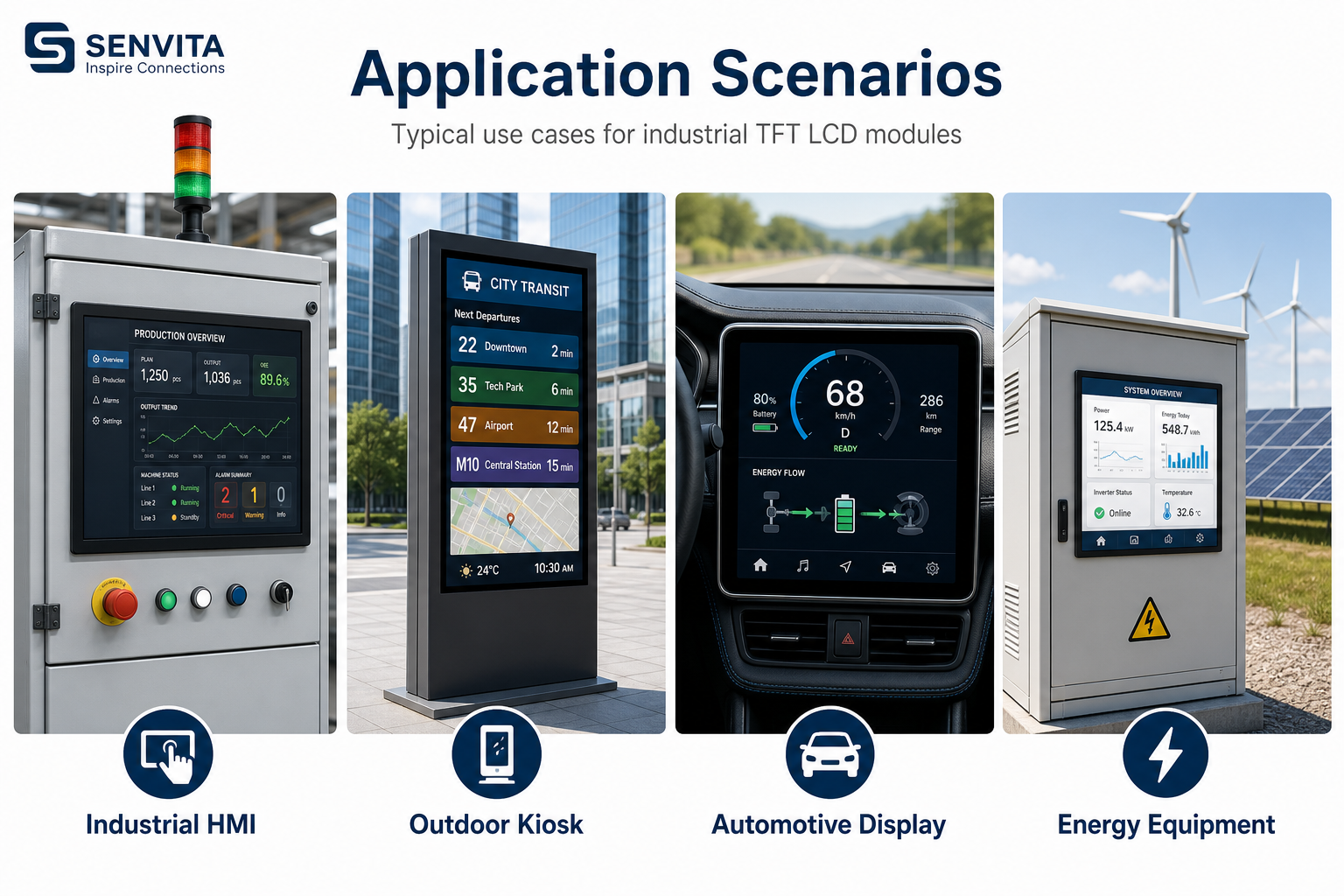
3. Representative TFT LCD Solutions from Senvita
To support different industrial applications, the following representative TFT LCD modules are widely used in real engineering projects.
✔ Industrial Standard HMI Display
STK070 HDFLD092 — 7.0″ TFT LCD
- Resolution: 1024 × 600
- Interface: LVDS
- Brightness: up to 1600 nits
- Operating Temp: -30°C to +85°C (industrial grade)
- Application: Industrial HMI, PLC systems, automation panels
This is one of the most commonly used configurations in industrial control systems due to its balance of cost, stability, and compatibility.
✔ High Brightness Outdoor Display
STK101 HDFLA034 — 10.1″ TFT LCD
- Resolution: 1280 × 720
- Interface: LVDS
- Brightness: 650 nits (custom high-bright options available)
- Wide temperature support
- Optical bonding optional
Designed for outdoor kiosks, energy systems, transportation terminals, and harsh lighting environments. Higher brightness variants can be engineered on request.
✔ Embedded MIPI Display Solution
STK050 FHFID103 — 5.0″ TFT LCD
- IPS panel, Resolution: 1920 × 1080
- Interface: MIPI DSI
- Brightness: 1000 nits
- Compact embedded integration
Suitable for modern embedded systems using ARM / Linux / Android platforms.
4. LVDS vs MIPI: Engineering Perspective
| LVDS Advantages | MIPI Advantages |
|---|---|
| Strong EMI resistance Mature industrial ecosystem Stable long-distance transmission |
High data bandwidth Suitable for high-resolution compact systems Common in mobile SoC platforms |
Recommendation: In industrial HMI applications, LVDS remains the preferred choice due to its robustness in noisy electrical environments.
5. Common Mistakes in LCD Selection
5.1 Insufficient Brightness
Leads to poor readability in real environments—especially near windows, outdoor enclosures, or high-bay factory lighting.
5.2 Ignoring EMI Conditions
Causes flicker, signal distortion, and unstable display behavior near VFDs, relays, and motor drives.
5.3 Interface Mismatch
May result in no display output, corrupted image, or intermittent failure during temperature cycling.
5.4 Using Consumer LCD in Industrial Systems
Leads to temperature failure, short lifespan, and unstable operation under 24/7 duty cycles.
6. Engineering Considerations Beyond the Datasheet
| Domain | Key Actions |
|---|---|
| Signal Integrity | Controlled impedance routing; differential pair matching |
| Power Design | Low ripple power supply; proper filtering for backlight driver |
| EMI Mitigation | Grounding strategy; shielding design; cable routing optimization |
| Thermal Design | Heat dissipation path; backlight thermal management |
7. Engineering Support & Custom LCD Solutions
Standard LCD modules are often not sufficient for industrial applications. Many systems require customization to achieve optimal performance. Senvita provides engineering support in:
- LCD interface customization (LVDS / MIPI / RGB)
- Brightness tuning for specific environments
- Wide temperature optimization
- Mechanical structure adaptation
- Optical bonding integration
🔧 Engineering Inquiry
If you are working on a new industrial HMI or embedded display project, we can support:
- LCD selection for system design
- Display integration troubleshooting
- Custom module development
- Application-specific optimization
Contact us for engineering consultation or RFQ support →
Conclusion
Selecting the right TFT LCD for industrial HMI applications requires a system-level engineering approach considering EMI conditions, interface selection, thermal environment, and optical performance. A properly selected display improves system reliability, reduces failure rates, and significantly enhances product lifecycle performance.